For Parents Of Kids With Big Emotions (Ages 3-13)
Stop Surviving Your Child's Meltdowns.
Start Actually Leading Them.
The Meltdown Map 2.0 is a system that gives overwhelmed parents a simple, repeatable plan to guide their child through the hardest moments.
Every time your child loses it, you lose it too... and you're exhausted from pretending that's okay.
You love your kid more than anything on earth. That's not the problem.
The problem is that somewhere between "I know yelling doesn't help" and the actual moment your child is screaming on the kitchen floor because their sandwich was cut the wrong way... your brain goes completely offline.
You freeze. You over-explain. You plead. You negotiate. You yell. Then you feel terrible about it for the rest of the day.
And the worst part? You know better. You've read the books. You've saved the Instagram posts. You've nodded along to the podcasts. You understand co-regulation and nervous system theory and "connect before you correct."
But in the actual moment... when it's 6:47pm and dinner's burning and your kid is melting down over the color of their cup... All that knowledge evaporates like it was never there.

What if the problem isn't what you know... it's that nobody ever gave you the order?
Simple secrets discovered by school psychologists that are used daily by child development specialists to guide kids through their biggest emotional storms.
but with a unique twist that lets you use them at home, in the chaos, when you're already activated and running on empty.
Here's what nobody tells you about meltdowns:
Most parents don't fail because they don't care. They fail because when a meltdown hits, they have no map.
They have puzzle pieces — "validate feelings," "set a limit," "stay calm," "repair afterward" — but nobody told them what order to put the puzzle together. So in the heat of the moment, they grab random pieces and shove them in wherever, and somehow the picture never looks right.
Without a clear sequence, you spiral into the chaos with your child instead of leading them through it.
Without the right words, you either go silent or say something you immediately regret.
Without starting with *your own nervous system first*, no amount of perfect phrases will actually work — because a dysregulated adult literally cannot guide a dysregulated child. That's not a character flaw. That's neuroscience.
And here's the part that stings: most parenting advice accidentally *skips* the part where you're losing your mind. It talks to the calm, well-rested, already-regulated version of you. The version that had a good night's sleep and already meditated and has a cup of warm tea nearby.
Not the version of you at 7am trying to get shoes on a child who has decided today is the day they hate all shoes forever.
You need this even if:
- You've tried every gentle parenting tip you've ever read and still end up yelling
- Your partner thinks you're overthinking it and you feel completely alone in this
- You don't have hours to spend learning something new
- You've already taken parenting courses that gave you theory but left you stranded in real life
- You consider yourself a calm person — except, apparently, as a parent
- Your child's meltdowns feel manipulative, exhausting, or completely out of nowhere
Here's the secret that changes everything:
You don't need more parenting information. You need a repeatable map for the exact moment when everything's falling apart.
The unusual method isn't another breathing exercise or a list of validation phrases. It's a step-by-step sequence that starts before you say a single word to your child — because the moment you try to help a melting-down kid before you've regulated yourself, you've already lost.
When you know the sequence, something almost miraculous happens: you stop getting swallowed by the moment and start leading it.

About Alex Anderson-Kahl
Let me introduce myself real quick.
My name is Alex Anderson-Kahl. I'm a school psychologist, and I got into this work because I wanted to help kids.
What I found instead was a School Psychology paradox: I became a school psychologist to help kids. That was the plan. Go in, support the children, change lives.
Except I quickly learned something that flipped everything upside down. The kids weren't the ones who needed me most.
I'd sit with a child who was struggling — melting down, shutting down, acting out. And I'd think, okay, let's work on this together. But then I'd meet the adults in that child's life. And I'd realize something uncomfortable.
The child was just reflecting what was happening around them.
The adults were overwhelmed. Exhausted. Running on fumes and guilt and good intentions with no real tools. They wanted to help their kid. They really did. They just didn't know what to do in the hardest moments.
I started my career working in residential treatment with delinquent youth. Kids many people had already labeled as difficult, defiant, aggressive, or too far gone. But the more I worked with them, the more I saw that behavior was rarely the whole story. Underneath the anger, the shutdowns, the outbursts — were children who had been hurt, misunderstood, overwhelmed, or never taught the skills they needed to cope.
That work taught me one of the most important things I've ever learned: behavior is communication. A child who is acting out is not a bad child. They are a child with a missing skill, an unmet need, or a feeling they haven't been given a safe way to express.
When adults dismiss a child's emotion, the child has to get louder to be heard. That became foundational to everything I've built.
I went back to school. Earned my advanced degree as a school psychologist. Got into the schools, tried to get upstream, help kids before they reached crisis. And I did help. But I kept running into the same wall.
I could have a good moment with a child. But then they'd go back into the same overwhelmed systems, the same stressed classrooms, the same exhausted homes. And the same patterns would repeat.
That wasn't failure. It was the lesson.
The leverage point was never the child. It was the adults.
If I wanted to help more kids, I had to help the adults first. I had to equip the people who loved, taught, and guided them every day.
That's when I built Raise Strong. That's why this course exists.
Here's what I'll say: I've spent years sitting across from hundreds of parents who were doing their absolute best and still drowning. I've seen what works. I've seen what makes meltdowns worse. And I've taken all of it and turned it into something you can actually use tonight.
Here's the honest truth about why this matters so much:
The way a meltdown ends teaches your child something.
When it ends in yelling and shame — they learn that big emotions are dangerous and get managed through fear.
When it ends in giving in — they learn that escalating gets results.
When it ends with a parent who stayed steady, acknowledged the feeling, lowered the heat, and connected without caving — they learn that emotions are survivable. That they're safe. That the adults in their life can handle the hard stuff.
That's not just better parenting. That's the foundation of emotional resilience. The thing that determines how your kid handles hard moments for the rest of their life.
Before The Meltdown Map 2.0

After The Meltdown Map 2.0

And here's what makes The Meltdown Map different from literally everything else you've tried:
It works even if you've already tried gentle parenting and felt like a failure.
It works even if your child's meltdowns feel extreme, frequent, or completely unpredictable.
It works even if you consider yourself "not a patient person."
It works even if your partner isn't on board.
It works even if the last three parenting things you bought are still sitting in your inbox, unopened.
Because it doesn't require you to be a different person. It gives you a sequence — a map — that works through the person you already are, starting with where you actually are when the storm hits.
Using The Meltdown Map, you can:
Walk into your next meltdown with an actual plan instead of white-knuckling through it and hoping for the best.
Stay regulated enough to lead, even when your child is at a full 10 on the chaos scale.
Know exactly what to say (and what to stop saying) in the moments that used to send everything off the rails.
Repair connection after a hard moment — without shame, without lectures, without it turning into another argument.
And slowly, consistently, start raising a child who learns that big feelings aren't something to be afraid of.
Here's how this was created.
The Meltdown Map didn't come from a content strategy. It came from a wall.
I kept watching the same scene play out — parents who wanted to do better, who knew the theory, who were genuinely trying — and still getting swallowed whole the moment their child escalated.
And I realized: they didn't need another podcast episode about emotional intelligence. They needed a sequence they could follow in the moment. Something their brain could grab onto when their nervous system was firing on all cylinders and "stay calm" felt like the most useless advice ever given.
So I took everything I know from school psychology — nervous system regulation, attachment theory, co-regulation, behavior as communication — and built a framework that works in order.
Five steps. In order. That's the map.
You could absolutely piece this together yourself.
Read the developmental psychology research. Study co-regulation theory. Take courses on nervous system regulation. Spend hours in parenting forums sorting through conflicting advice. Test approaches on your actual child during actual meltdowns while running on actual sleep deprivation.
I read the books. I sat in the clinical rooms. I watched what worked and what spectacularly didn't. I tested the frameworks, refined the language, built out the sequences.
That took years...
Or you can get the whole thing (condensed, sequenced, and ready to use) for only $97.
No fluff. No filler. No 47-module course you'll never finish.
The Meltdown Map 2.0 is built to be used, not collected.
You can use it even if you've got zero time.
You can use it even if you've tried everything.
You can use it even if the last parenting thing you bought is still sitting unopened in a tab somewhere (no judgment — I've done the same).
Here are 5 things you'll discover inside the meltdown map 2.0
Here's the deal.
I stripped out every piece of fluff, theory, and "but first, let me tell you about attachment styles" preamble and left only what you can actually use when your child is losing it at bedtime.
This isn't a 12-week program. It's not a certification course. It's a map — which means you learn it, you practice it, and then you use it the next time a meltdown hits.
Which, if your household is anything like the families I work with, means you'll have a chance to practice it very soon.
Don't do what I did... or what most parents do.
Don't spend months scrolling Instagram parenting accounts collecting tips that all contradict each other. Don't buy the $300 program that gives you so much information you can't remember any of it when you actually need it. Don't keep waking up at 2am feeling guilty about how today went, promising yourself tomorrow will be different without any new tools to make it so.
I've done the research. I've made the mistakes... watched approaches crash and burn and adjusted until I found what actually works. I've done the years of sitting across from families in real pain to figure out what makes the real difference.
You can get all of that, condensed into something you can actually use, for the cost of a dinner out.
The Price for all of this is $97
And honestly? For what's inside, that number almost embarrassed me to type.
Still not sure $97 is worth it?
Let me ask you something
What is one fewer meltdown per week worth to you?
What is *not* spending the drive to school replaying the morning's chaos in your head worth?
What is your child looking at you — mid-meltdown — and actually starting to *calm down* because you knew what to do... what is that worth?
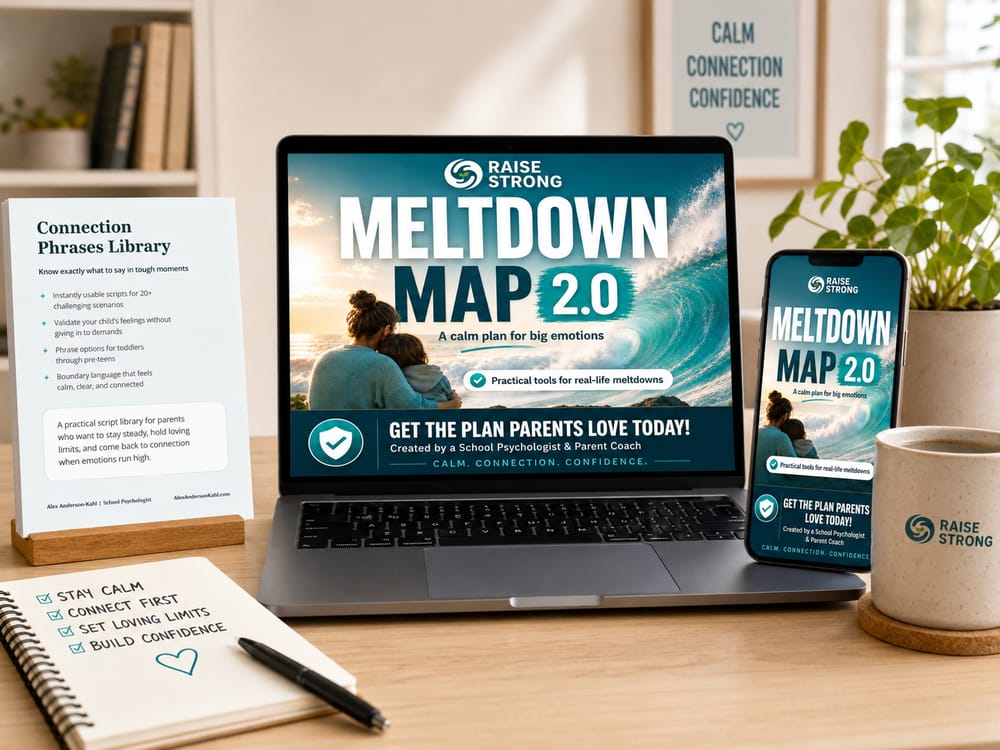
Here's Everything you get:
- Meltdown Map 2.0, your step-by-step framework for navigating meltdowns, shutdowns, power struggles, and big emotions in real time. Not after. Not in theory. In the moment.
- Nervous System Regulation Tools for Parents, because you can't help your child regulate if your own nervous system is already on fire.
- After the Storm Repair Guide, what to do and say after a hard moment to rebuild connection and trust.
- Connection Phrases Library, real words for real moments, so you're never standing there thinking, "I know I'm supposed to say something but what?"
- Lifetime Access + Future Updates, this grows with you and your child.
Total value: $575
Today Just: $97
You save $478 off this stacked value.
Our Guarantee.
Here's my promise:
Go through The Meltdown Map 2.0. Use the C.A.L.M.S. framework. Try the Connection Phrases. Work through the repair process.
If you do the work and honestly feel like it wasn't worth every penny — email me within 14 days and I'll refund you completely. No hoops. No "but did you really try it?" No awkward conversation.
I'm that confident in what's inside.
The only way you don't get results is if the course stays in your inbox unopened — and I can't help you there. (Though I do hope the guilt about the unopened course is some motivation.)
One thing worth knowing
The $97 price exists right now because this is a new launch and I want to get this into as many hands as possible. When the launch window closes, the price goes up. I'm not going to pretend I don't know when that is while secretly leaving it at $97 forever. When it's done, it's done.
If this page is live and the button is still working, you're in time.
One final warning:
Nothing changes if nothing changes.
The next meltdown is coming. Maybe tonight. Maybe tomorrow morning when there's a sock seam in the wrong place and the world ends.
You can hit that moment the exact same way you've been hitting it — white-knuckling it, reacting, feeling terrible afterward, promising yourself you'll do better next time.
Or you can hit it with a map.
Not a perfect parenting persona. Not a scripted response you memorized in a calm moment and forgot the second your heart rate went up. A real, step-by-step sequence built for the actual messy moment — starting with your nervous system, moving through the storm, and landing on the other side with your connection intact.
That's what's waiting for you inside The Meltdown Map 2.0
Your kid doesn't need a perfect parent. They need a steady one. Let's build that.
— Alex Anderson-Kahl, Raise Strong
Order
Items
Summary
Know What to Do When Big Emotions Take Over
You do not need to guess your way through the next meltdown.
The Meltdown Map 2.0 gives you a clear, psychology-backed plan for staying steady, understanding what your child's behavior is communicating, and guiding the moment with more calm and connection.
Raise Strong's core promise is to help parents move from daily battles to deeper connection through psychology, empathy, and practical strategies they can use right away.
5-Step Framework
Connection Scripts
Instant Access

Secure SSL Payment
Payment data stored on a secure server

Money Back Guarantee
14-Day Risk-Free