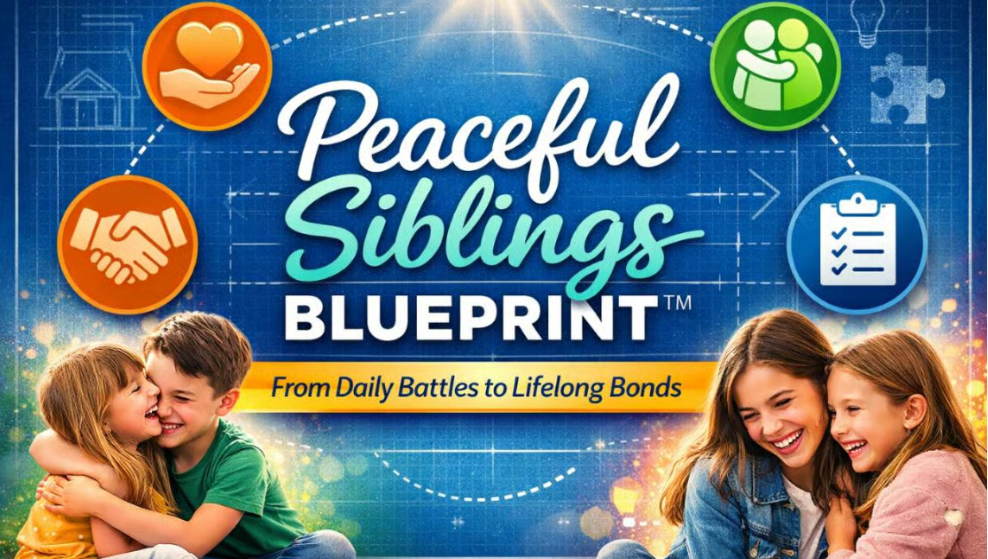
Your children are at different stages.
The course includes age-specific repair examples for ages 1–3, 4–7, and 8–12. Adjust the words, choices, and support to what each child can manage.
 RAISESTRONG
Handle bickering, tattling, and “that’s not fair!” with a clear plan for what to say, when to step in, and how to help your kids make things right.
Start with one familiar conflict.
14-day money-back guarantee.
Or choose 3 monthly payments of $99. Same $297 total.
Actual included pages shown. Digital resources for your phone or printer.
See exactly what your $297 includes Alex Anderson-Kahl, Ed.S., NCSPSchool psychologist & certified parent coach
You’re handling everyday bickering, teasing, tattling, and arguments about toys, turns, or personal space. You want to feel capable of helping your children through it without feeling pulled apart yourself.
The course includes age-specific repair examples for ages 1–3, 4–7, and 8–12. Adjust the words, choices, and support to what each child can manage.
The bonus FAQ addresses big age gaps, with guidance for developmentally appropriate expectations. Your children can need different kinds of help in the same disagreement.
Module 4 covers the recurring “instigator” pattern, including quiet button-pushing and loud reactions. Learn to notice what happened and hold a boundary while protecting each child’s dignity.
Begin with your own response. Day 7 of the email sprint includes a three-minute caregiver check-in to agree on one boundary, one phrase, and one way to help.
The ages above describe the course’s repair examples. Choose support that fits each child’s development and abilities. This program is for everyday sibling conflict; serious or repeated harm needs individualized support.
Dinner’s half made. One child is crying. The other is explaining why it wasn’t their fault. You’re trying to hear both sides while your own patience is running out.
Maybe you’ve tried reminders, taking the toy away, or telling them to work it out. Then the next argument pulls you back in before you’ve finished what you were doing.
Parenting advice can be hard to use when two children need you at once. The Peaceful Sibling Blueprint puts the next step within reach, with words to practice and a response you can return to.
You can hold a firm boundary and make room for feelings. Give yourself a response to practice, then help your children build the skills behind handling disagreement and making things right.
A familiar response gives you something to reach for when the noise makes it hard to think.
Notice your own reaction, interrupt unsafe behavior, and help your children take space. Practice a quick reset so you can choose your next words.
Respond to bickering, tattling, and disputes over toys or turns with clear language. Hear what each child needs and guide a manageable next step.
Return when everyone is ready. Help your kids try the request again, return what was taken, or make a repair that fits what happened.
When everyone is calm, start here.
“What happened, and what could help make it right?”
Help your child choose one manageable action. A repair could be:
From Day 11 of your Implementation Sprint. Practice a concrete repair without forcing an apology or a hug.
Know what you’re opening, where to find it, and how each part helps when the same disagreements come around.
Five core modules + bonus FAQ, with lifetime course access. Learn the approach to regulation, boundaries, conflict, repair, and connection, with a Start Here section to orient you. Return to the lessons whenever you need a reminder.
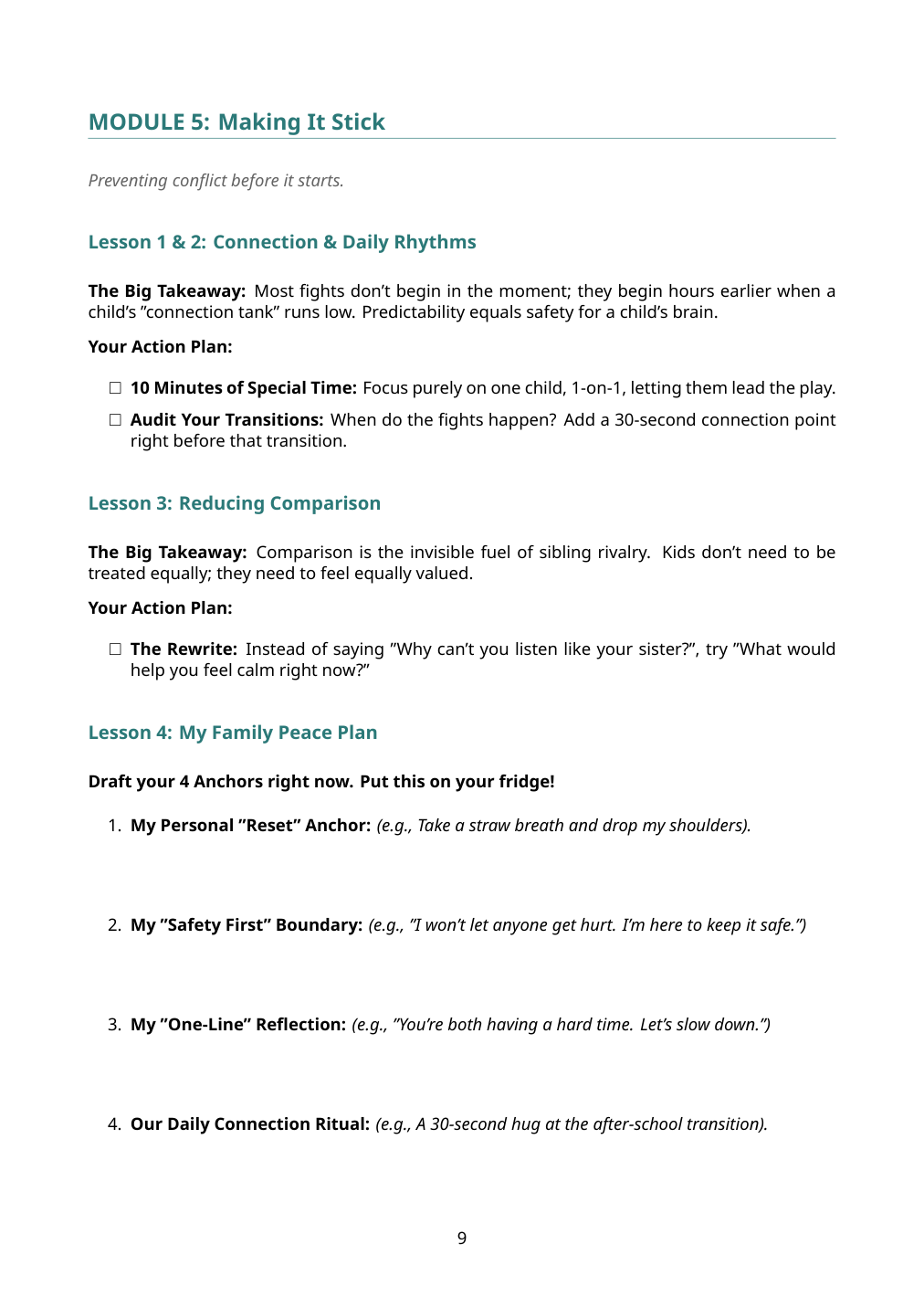
A 10-page downloadable PDF. Use the action steps and reflection prompts to build your own Family Peace Plan. Find it in Start Here → Companion Workbook & Action Guide.
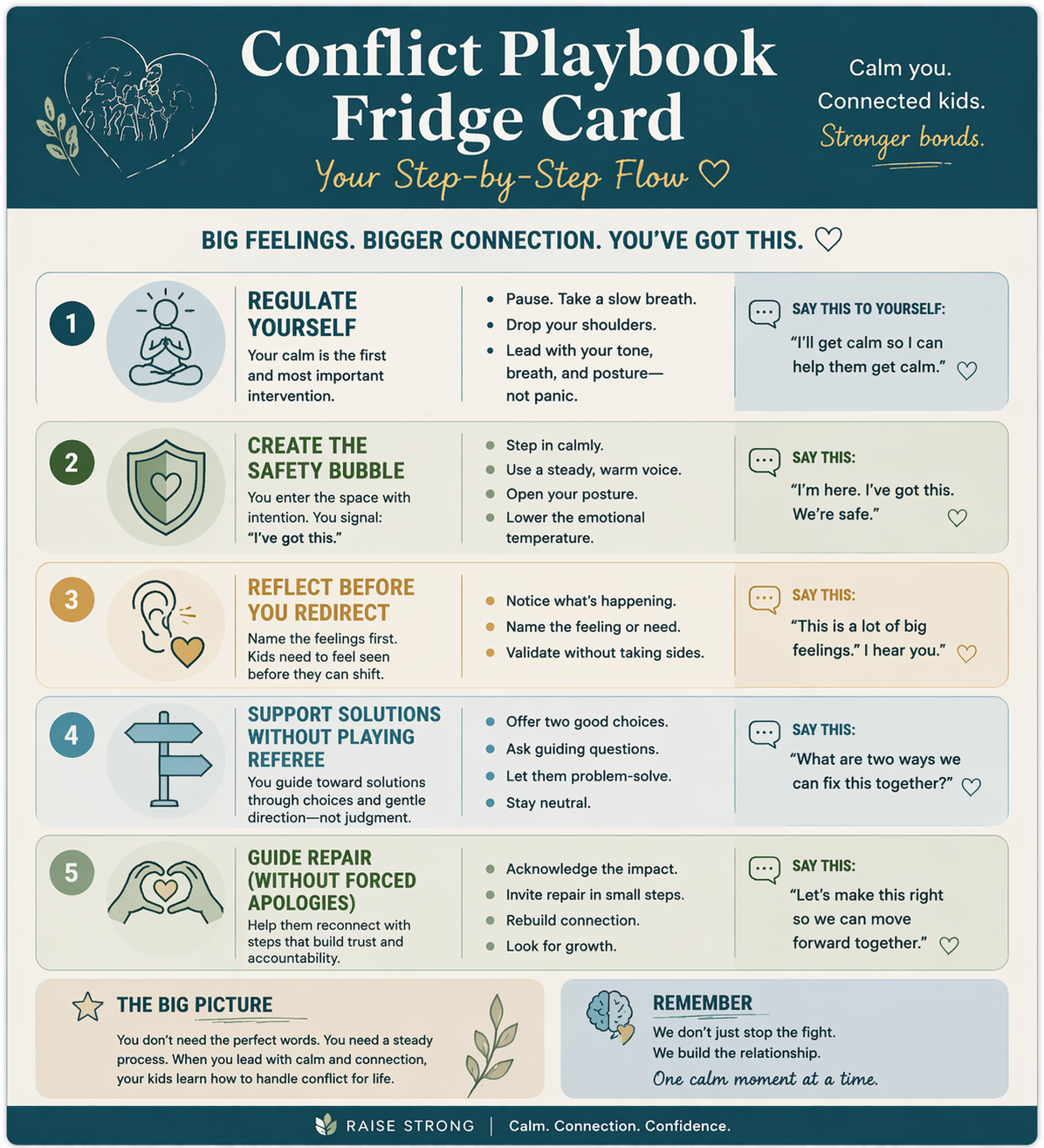
Individual downloads in the Printable Vault. Open a named tool for the moment in front of you, including the Conflict Playbook Fridge Card, decision tree, and scripts.
14 days of guided practice. Short missions, scripts, rescue options, and caregiver handoffs help you return to one useful step, even after a difficult day.
The workbook is included as a PDF. The Conflict Playbook is taught in Module 3 and summarized on your Fridge Card. All materials are digital; physical books and devices are not shipped.
Tap either preview to read it at full size in a new tab.
Five core modules + bonus FAQ, with the companion workbook, nine reference tools, and the daily email sprint included.
Recognize patterns behind bickering, rivalry, and competition, so you can consider what each child needs before choosing your response.
Practice a quick reset for the moment you feel your voice getting louder. Give yourself a way to settle before you hold the boundary.
Have words ready for toys, turns, personal space, teasing, and tattling. Use a repeatable process when you’re being pulled into “who started it.”
Help your children make things right after a clash, with repair, empathy, and reconnection beyond a forced “sorry.”
Choose one recurring challenge, build a manageable practice, and work toward a response the adults in your home can use consistently.
Find guidance for the questions and messy moments that come up as you put the approach into practice.
Your 14-Day Implementation Sprint arrives as brief daily emails. Each brings a 2–5 minute mission, a script to practice, and a rescue option for a hard moment.
Miss a day? Choose one useful step and keep going. You can return to the other emails when you have room.
Nine individual downloads, organized by name. Open the tool that fits the moment, then keep it on your phone or print it.
Your purchase includes all four parts: course, 10-page workbook, nine reference tools, and guided email practice. All resources are digital.
Begin with the 4-minute, 37-second welcome, then choose one reference card. You can give yourself a useful starting point before working through the full course.
Sign in with your checkout email. Open Start Here → Your Calm, Clear Beginning. The 4-minute, 37-second welcome shows you the roadmap. Your Companion Workbook & Action Guide is in the same section.
Open Printable Vault → Conflict Playbook Fridge Card. Save it on your phone or print it. You’ll have the five-step flow where you can find it.
Notice what happens during one recurring window, such as after school through dinner. Use the daily emails to choose one response to practice and return to.
Lifetime course access · 14-day money-back guarantee
Ed.S., NCSP · School Psychologist · Certified Parent Coach
I’m Alex Anderson-Kahl, the creator of Raise Strong. I combine school psychology training with parent coaching certification through the JAI Institute for Parenting, a year-long program with 180 contact hours.
When two children are upset, “stay calm” can leave you wondering what to do next. I created the Peaceful Sibling Blueprint to turn that moment into a clearer sequence: protect safety, hold the boundary, and return to repair when everyone is ready.
You can build a steadier response, one moment at a time.
Begin with the toy dispute, the teasing, or the after-school bickering you already know you want help with. Your complete bundle gives you the approach, the practice, and the words to keep nearby.
Where would you like a clearer next step?
Start with the Rule Dispute 90-Second Protocol and Conflict Playbook Fridge Card. Practice a clear boundary and a next step for toys and turns.
This is a starting point. Your purchase includes the complete bundle.
| Everything included | Est. value |
|---|---|
| Peaceful Sibling Blueprint course + workbook Five core modules + bonus FAQ, with the 10-page companion PDF | $297 |
| 14-Day Implementation Sprint Daily emails with a small mission, script, and rescue option | $197 |
| The Printable Vault Nine individual reference downloads, listed above | $147 |
| Total estimated component value | $641 |
Estimated component values are a guide to the bundle’s value, not previous selling prices.
Course + workbook + nine reference tools + guided email practice. Sign in with your checkout email.
Or choose 3 monthly payments of $99. Same $297 total.
Explore the course and put a response into practice. Your purchase is covered by the 14-day money-back guarantee.
A little clarity about what you’re getting and how to begin.
Use your checkout email to sign in. Open Start Here → Your Calm, Clear Beginning for your 4-minute, 37-second welcome, then the Companion Workbook & Action Guide. Find your first tool in Printable Vault → Conflict Playbook Fridge Card. Your welcome email includes course access instructions. The first sprint exercise arrives about 24 hours after purchase, followed by daily practice emails.
Your downloadable book is the 10-page Companion Workbook & Action Guide. The Conflict Playbook is taught in Module 3 and summarized on the included Fridge Card. The nine reference downloads are listed by name on this page. All resources are digital.
The email sprint includes rescue options, a troubleshooting plan for refusal, and a Bad Day Plan for repairing and resetting after you lose patience. You can simplify the next step and return to problem-solving when everyone is ready.
The Printable Vault contains nine named downloads. Start with the Conflict Playbook Fridge Card for the overall flow. Use the decision tree when you are unsure whether to step in, or open the specific bickering, tattling, teasing, rule-dispute, or repair tool that fits the moment.
Yes. Begin by practicing your own response. Day 7 of the email sprint includes a three-minute caregiver check-in to agree on one boundary, one phrase, and one way to offer help. Use the included cards and workbook together to agree on a shared next step.
Module 4 includes a lesson on the recurring “instigator” pattern, including quiet provocation and a louder reaction. It helps you focus on what happened, protect safety, hold the boundary, and guide repair without assigning a permanent role to either child.
The repair lessons include specific examples for ages 1–3, 4–7, and 8–12. The bonus FAQ also addresses big age gaps. Adapt your words, choices, and expectations to each child’s development and abilities.
You can begin by practicing your own response: interrupt unsafe behavior, hold a clear boundary, and help everyone take space. Return to problem-solving and repair when your children are ready, with support that fits their needs. The sprint includes rescue options for moments when the first step is hard.
A phrase is one part of the process. The course explains the approach, the sprint helps you practice it in small steps, and the printable cards keep a reminder nearby. You’ll have guidance for what comes before the words and what to do after the argument, too.
Begin with the welcome and one card, then return to the course at your own pace. The daily email missions take about 2–5 minutes. If you miss a day, choose one useful step and return to the other emails when you can.
The welcome video is 4 minutes, 37 seconds. As one example, “Why Your Calm Matters More Than Your Words” is 5 minutes, 30 seconds. Lesson lengths vary; you can pause and return to them. The 2–5 minute daily missions are separate practice exercises. Download the workbook and reference cards to your device so you can return to them when a familiar disagreement comes up.
You receive lifetime course access. Learn at your own pace and return to the lessons whenever you need a reminder. The 14-Day Implementation Sprint is your daily practice schedule. Your 14-day money-back guarantee is the refund window; your course access continues beyond it.
No. This is a standalone program. Your purchase includes the course, companion workbook, all nine reference tools, and the implementation sprint.
Your children will still disagree. You’re learning a way to respond and teach the skills that can help them handle conflict and repair. Notice changes in your own response, how disagreements unfold, and the support your children need. Each family’s progress will be different.
The complete bundle is digital. Pay $297 once, or choose three monthly payments of $99 for the same $297 total. The installment option commits you to all three payments and is not an ongoing subscription. Physical items are not shipped.
Yes. Your purchase is covered by a 14-day money-back guarantee, so you have time to explore the course and try the tools.
Protect everyone’s safety first. This program is parenting education for everyday sibling conflict. If conflict includes serious or repeated harm, seek individualized support from a qualified professional alongside any resources you use at home.
Tomorrow’s after-school bickering. The fight over turns. The argument that starts while you’re cooking. Start there. Learn how the Blueprint approaches that situation, choose one response to practice, and keep the matching tool nearby.
Feel more capable of helping your kids through conflict, with a plan you can return to when you’re being pulled in both directions.
Get the Blueprint for $297$297 USD, paid once · Lifetime course access · Workbook + nine reference tools + daily email practice · 14-day guarantee
Or choose 3 monthly payments of $99. Same $297 total.
$297One-time payment
Get the Blueprint